Look at me, tossing up another blog post and not waiting months (or even years) to do it. But seriously, I do have a quick question for y’all.
Has anybody read Ain’t No Saint Nick? I ask because I really loved that story. To me, it really was Hallmark Christmas meets Die Hard. The few reviews it got tells me it was well received, but…there aren’t many. I know, I know, people prefer series. Or at least a sequel.
Well…what if I told you that there may be another Nick story coming? What if I told you that as we speak, my editor is doing her level best to get it polished so you can have it for Christmas? Any takers? Would that stimulate folks into maybe putting up reviews for either of them? What if I could promise you that you’d make it to Santa’s Good List if you put up a review? I mean, I’m not saying for certain that I could get you off the naughty list, because let’s face it, some of us deserve being on that list. But I bet it would go a long way towards getting your name shifted OFF the Naughty List and onto the Good List if you left reviews. Santa knows how important reviews are to authors. I’m just saying.
I can’t make any promises, but I can tell you that we’re all working feverishly to get this thing polished up in time.
I’ll let you know up front: the story didn’t exactly go the way I intended. But, I’ve also found over the years, that the story tells itself. I just have to let go and type it. I guess we’ll just have to see how it’s received. Anywho, here’s hoping you all had the greatest of Turkey Day celebrations. I also hope you all have the merriest of Christmases or Kwanza or Hanukkah or Yule or…yeah, you get the picture.
Love you guys! Here’s wishing you lots of love, luck and bacon in the coming new year! Heath
Welcome back to the blog! Pull up a seat and get comfortable because today we have an exciting author to talk to. If you’ve never heard of Scott M Baker, you’re about to!
Me: Tell us a little about yourself. Are you married? Do you have any children? Scott: I’m a native Bostonian, born and raised in its suburbs. I spent twenty-three years working for the CIA, spending seventeen years in northern Virginia and six in Okinawa and South Korea. I now live in southern New Hampshire with my two cats (Archer and Michonne) and Fred, my Beagle-Bassett mix, who is the biggest distraction to my writing. I teach full-time at a public charter school in Manchester, New Hampshire. I’ve been married twice and divorced twice, which explains my fascination with horror. My only child is my stepdaughter, who loves me more than her biological father. Me: I can relate to that. Of my seven kids, my ‘step’ son looks the most like me. I should have adopted that kid when he was little. Scott: I’ve been interested in writing since I was a kid, but I only started doing it professionally in 1989. Back then, I wrote techno-thrillers. My first book sucked so bad that I’ve never allowed anyone to read it. The second was much better but never got published. My third thriller, about North Korea acquiring nuclear weapons and threatening to use them against the United States, was sitting with a big publisher in New York who was drafting a contract when 9/11 occurred. The market for techno-thrillers dried up overnight. Me: Yeah, I can definitely see that happening. Talk about bad timing. Still, would you be the writer you are today, specifically, the genres you work in, if that hadn’t happened? Scott: After the Gulf War was over, I wanted to get back to writing, but did not know in what genre. A friend and I went to see Van Helsing with Hugh Jackson. Afterwards, she asked what I thought about the movie. I replied that it was fun, but I could write better than that. She smiled and asked, “Why don’t you?” Six years later, my first novel – The Vampire Hunters – was published, and I have not stopped writing since then. Me: Isn’t it crazy what can trip that trigger to start things rolling? What do you do for relaxation? Scott: What is this strange word of which you speak? I’m a writer and a teacher. Relaxation is a rarity. When I do get a few minutes to myself, I enjoy reading, watching bad horror movies (I live on Tubi), and spending time with friends. When I do finally take extended relaxation time for myself (usually when I get writer’s block), I play video games, which lasts until I get into a boss fight I can’t win, then I say screw it and go back to writing. I’m addicted to the Fallout and Metro franchise. Me: Okay, I can relate. For me it’s Rainbow Six. Who is your favorite author(s) (and is there a reason why)? Scott: Topping the list is Graham Masterton. When I was a kid, my mother let me read horror, not caring about the genre as long as I was reading. I started with the classics (Shelley, Poe, Wells, Stoker). When I was ten, my mother bought me The Manitou for Christmas. I stayed up all night reading that book and have been hooked on modern horror ever since. There are so many other great writers I love. Ed Lee, whose books are over-the-top gore (his Infernal series about hell is brilliant). Robert Lumley’s Necroscope saga, which features the most unique vampires. World War Z by Max Brooks, one of the most brilliant and innovative zombie novels I’ve ever read. Also within the zombie realm are Camille Picott’s Zommunist Invasion series (Red Dawn meets Night of the Living Dead), Allen Gamboa’s Dead Island series (zombies with an 80s action movie flair), and Jeff Thomson’s Guardians of the Apocalypse, which has the Coast Guard battling zombies that have taken over Oahu (it’s zombie killing porn). Me: There are some authors in that list that I haven’t heard of. I’m so glad that Google is my friend! Are there similarities between you and any of the above-mentioned authors? Scott: Just that we all love writing and enjoy putting different spins on the genre to keep it alive. Allen, Jeff, and I have twisted minds that make drafting bizarre plots so much easier. Me: And it’s that twisted sense of humor that I think readers love. Why do you write? Scott: Because I love it. Writing is a major part of my life. No matter how bad my day is (and as a teacher, I have really bad days), an hour in front of my laptop living in a make-believe world sets me right. Me: Escapism. I get it. I really do. So, what is a typical working day like for you? Scott: During the school year, I wake up, drag myself to work, try not to murder sixth- and seventh-graders, drive home, reevaluate my decision to teach, then go to bed and dream of becoming a best-selling writer so I can quit. Me: Yeah, I’m nearly thirteen years into trying to be an overnight success, so I feel you on that one. Scott: On those days I’m not a teacher, I spend the late morning and early afternoon writing. After dinner, I work on updating my social media and marketing.
Me: I hate that part. I really thought that the hardest part would be writing the book. Pft…boy was I wrong. So, when and where do you write? Scott: I prefer to write outside. I love the fresh air and, where I live, the neighborhood is full of critters. There are no distractions, so I actually get work done. I bring with me a black iced coffee (as I tell the kids at school, I like my coffee as I like my soul – cold and dark) and two cigars. I write until the cigars are burned out, an average of a thousand words in one sitting. On those days when it’s too wet or cold to be outside, I usually go to the local cigar bar. Me: Okay. That sounds peaceful. What kind of research do you do for your books? Scott: A lot. In my latest post-apocalyptic book, A World Gone Dark, I conducted extensive research on EMPs and solar flares, prepper techniques for staying alive, and how to handle a nuclear reactor meltdown. Getting things accurate is vital. I could publish the most extraordinary novel ever written, but if I miscount the number of rounds in a weapon or get a geographic location wrong, I lose my readers. Me: I know what you mean. I hate reading books where the author didn’t even bother to look at the difference in a revolver and an automatic. Their character ‘throws a new clip’ into his revolver and…yeah. I’m done. How do you conceive your plot ideas? Any tricks I should know about or could steal from you? Scott: With an overactive and twisted imagination. What makes my books stand out is that I always add an interesting yet believable twist to my plots. In The Vampire Hunters, I make the masters major characters with back stories and histories so they’re not merely monsters. My first zombie series, the Rotter World saga, follows humans and vampires as they overcome their hatred to survive the zombie apocalypse. I’m a World War II history buff, and my second wife made me watch every episode of Ancient Aliens, which prompted me to create Operation Majestic, which has the tagline Raiders of the Lost Ark meets Back to the Future – with aliens. Sometimes I get my ideas from others. When my stepdaughter was fourteen, she responded to every dad joke with an eyeroll, saying, “This is why we can’t have nice things.” A few years later, I wrote This Is Why We Can’t Have Nice Things During the Zombie Apocalypse, a story about a living-dead outbreak told from a teenager’s perspective. Me: Again, isn’t it crazy where our inspiration can come from? I got the idea for Sinful at a softball game because a high school boy sitting next to me couldn’t stop staring at a girl’s butt. I’m not going to elaborate. So, when naming your characters, do you give any thought to the actual meaning? Scott: Only on a few occasions. Most of the time, I give my main characters names that fit their profile. My secondary characters are loosely based on people I know. For example, the prepper community one of my MCs stumbles upon in my latest novel is loosely based on my colleagues at school. All the animals in my books are based on my pets or those of my family and friends, which is one reason they seem so realistic. Me: I base many of my characters on people I know. It’s just easier to give them all a unique voice. So, what are the major themes of your work? How long on average does it take you to write a book? Scott: Except for The Deadliest Breed of Assassins, my only published techno-thriller, all my books fall into the horror or Sci-Fi genres. I’ve written three zombie series and one paranormal series, plus other stuff in the horror genre. When I’m able to write full-time, it usually takes me three months to draft a book and another three to edit the manuscript and get it published. Me: As a writer, you can most surely weave an internal struggle into your storyline, and the reader may not realize it until the end. That’s when your audience has that sudden realization: Oh yeah, I didn’t see that coming. Do you know what I mean? Is that something you do often? Is that a writing style you prefer? Or are your stories an “open book” so to speak? Scott: My novels are all “open books.” I weave personal struggles and growth into the plot so that when the characters make life-or-death decisions, the reader is on the edge of their seat, wondering what will happen next. I hate books where, at the last minute, you find out the main character is “the chosen one.” That’s poor writing. I also throw in plot twists, but most of the time I foreshadow them so the reader can say, “I should have seen that coming.” Me: And I don’t think readers truly understand just how hard that is to do. To successfully pull that off, you have to always be thinking of how and where you can drop those little hints for the big reveal to make sense. Who are your target readers? Scott: Most of the readers for my zombie and paranormal novels are single women aged twenty-five to forty-five. That’s why Nurse Alissa vs. the Zombies and the Tatyana paranormal series are my most popular books because the main characters appeal to that audience.
Me: What do you think readers search for in a book? Scott: Readers love characters they can relate to. One of the reasons A World Gone Dark is so popular is that I show how ordinary people will cope with a solar flare that wipes out all electronics worldwide. Me: And I thought seriously of tapping into that very same idea. How do people get their insulin if there’s no power? The struggle to find clean water, safe food, etc. What is your favorite part of a book? Scott: The action scenes. I hate books where you read through two hundred pages and the climax is only three pages long. When I write my books, I want to fill them with so much action that the readers can’t put them down. However, the hardest part is coming up with action sequences that are realistic yet more action-packed than the books that came before, and that feature unique zombie kills. Me: It can’t be easy to always try to top the previous fight scene. Eventually you feel like you’ve written yourself into a corner (at least, that’s what it’s like for me). What is the hardest part of writing for you? Scott: Editing. I know it’s an integral part of being a writer. What frustrates me is that I have two Beta readers pick apart my manuscript, edit it two or three times, and run spell-check and grammar-check. Yet, after it’s published, I still find spelling and grammatical errors. Me: Oh man, I know what you mean. I’ve got a pretty savvy editor, and she’s really good at what she does. But even still, sometimes afterward, I’ll find some tiny little thing, and I’m left wondering how in the world it was missed. What is the best thing about being an author? Scott: Being a storyteller. I don’t write about politics, religion, or social issues. I want to entertain my readers and help them escape reality. The best compliment I can get is when someone tells me they read the book in one sitting because they couldn’t put it down. I also love attending conventions and chatting with horror fans, even if they don’t buy the book. I just love sharing stories about things we both love. Me: I like that. Do you listen to music while you write? Scott: No. I prefer no distractions. Me: I need some kind of music in the background. White noise, if nothing else, but I prefer epic movie scores or Viking battle music. I think it helps to stir the emotions when writing an action scene. What and/or who inspires you? Scott: Everything. Many times, I’ve turned a news story or an off-the-cuff comment into a story/novel. Years ago, I was challenged by someone to write a tentacle sex short story for an anthology he was publishing as a fundraiser for an oceanographic institute he represented. I didn’t want to write about a young Japanese girl being molested by an octopus, so I drafted a story about a sexually frustrated, middle-aged housewife who had a consensual affair with a giant starfish in the Caribbean. What broke me up was that he rejected my story, telling me I was a pervert. Me: >bursts out laughing< I had to laugh at that. I’m sorry. People are so weird sometimes. Have you ever collaborated on a book? If so, who was the other author? How did you collaborate with that author? What writing process did you use? Scott: I did once. The Collector, which is still available on Amazon. It was about a demon who arrives in Haddonfield, Illinois, around the time Michael Myers was born and induces people to commit violent crimes, collecting the souls of the innocents who died. Each of us wrote one chapter and passed it to the writer in the lineup. The best part was that each writer tried to outdo the previous one in terms of violence and gore. I loved that collaboration effort. Me: That sounds like fun. So, if you wrote a book about your life, what would the title be? Scott: I don’t think I ever would. The only part of my life that would be interesting is my time with the CIA, but most of that book would be censored by the Agency. Me: And I wish I had known you when I was penning Bobby Bridger’s first book. It would be the little things that I’d want to pick your brain on to make the story feel more realistic. Maybe another time. So, what question have you always wanted to be asked in an interview, but never have? Scott: Who would I want to portray me if my life were made into a movie? Chris Pratt has my sense of humor and would play me well, though he’s younger and a lot more handsome than I am. Me: Yeah, I’d have to have John Candy play me, I think. What have you written? And what are you working on at the moment? What’s it about? Scott: I’ve written primarily about zombies, but I’ve also created a paranormal series, a young adult series about a scientist whose experiment blows open portals between Earth and Hell and her sixteen-year-old son who goes around the world attempting to close them (the Shattered World saga), a 1950s style big monster novel (It Came From the Desert), time traveling Nazis (Operation Majestic), Allied intelligence officers battling Nazi occultism during World War II (OSS: Office of Supernatural Services), and a dystopian/post-apocalypse novel (Frozen World). The series I’m working on now, and which I think is one of my best works, is A World Gone Dark. It’s part of the Ravaged Skies saga, in which thirteen writers represent the same event—a massive solar flare that immobilizes all electronics across the globe—from different perspectives. The books are fantastic and recently dominated last month’s Written Apocalypse Book Battle Royale. I’m making the final edits on A World Gone Dark II: Survival and hope to publish it in January 2026. Me: Sounds like you’ve been busy! Where can we buy or see them? Scott: All my books are available on Amazon in Kindle/Kindle Unlimited formats, as well as in print. You can find them at https://www.amazon.com/stores/Scott-M.-Baker/author/B003N4U9BK.
M: What advice would you give to your younger self? Scott: To just hang in there and enjoy yourself. Some great things are heading your way. Me: What advice would you give to aspiring writers? Scott: Write. I know so many would-be writers who have filled notebooks with character development and world-building but never put a word of their story on paper. If you write one word a day every day for a year, you will have a full-length novel ready to publish. Me: Is there anything that you would like to add? Scott: I want to thank all my readers who follow me and patiently wait for my next book. I hope readers of this interview give my books a try and become fans. As long as you keep on reading my books, I’ll keep writing them. Me: Last question, what do you consider your best accomplishment? Scott: That’s hard to say. I’ve lived a good life. I served my country and had the opportunity to travel throughout Europe, Asia, and the Middle East. I’ve been a good stepparent and hopefully a good son. I’ve had a positive impact on several of the students at my school. And I’ve entertained thousands of people over the past sixteen years. I’ve been fortunate with what life has given me, and I hope I can continue to contribute for the next 20 or 30 years. Thanks to everyone who read this interview. I wish you all the best in life and hope many of you will become fans of my books. Me: And there you have it, folks. Scott M Baker. Novelist, storyteller, CIA super spy, teacher, purveyor of fine cigars, and an overall awesome guy. With the different stories this guy has shared, there has to be something in his stable that trips your trigger. I invite you all to check out his offerings and let the world know that you enjoyed his writings. Reviews, people. Leave reviews. It’s probably the single biggest make-or-break for authors. As I close out this interview, here are the links to where you can find more about Scott. I wish we had touched more on his extensive YouTube offerings. There’s a lot there to go through. Thanks for dropping by! blog: http://scottmbakerauthor.blogspot.com/ Facebook: https://www.facebook.com/groups/397749347486177/ Twitter: https://twitter.com/vampire_hunters Instagram: https://www.instagram.com/scottmbakerwriter/ YouTube: https://www.youtube.com/channel/UC5AyCVrEAncr2E0N5XoyUdg/playlists
Jeffrey Kosh Author, Graphic Artist, International Man of Mystery
Doctor Richter Townhouse
To personally meet Jeffrey Kosh one needs to travel to a place that doesn’t exist, as he is currently living at 22 Kronenstrasse, in Goldstadt, the capital of Wissenheim. This is the home—and office—of Doctor Maximilian von Richter, forensic pathologist and criminologist. The good doctor has provided Jeffrey with a small spare room inside his townhouse in order for him to continue his chronicles of terror. In fact, after a long hiatus from writing, my old friend and cover artist has decided to leave our time and isolate himself in this fictional city. The current year here is 1922 and it’s charming and refreshing looking at Ford Model T and Duisenberg cars dodging horse-drawn calashes and early delivery vans. I’m received by Ronny Cicero, Richter’s butler. He is a short, nasal-toned, and mischievous-looking fellow of Italian origins who never ceases babbling. He fills my ears with questions that he then answers himself, and in the short trip that takes from the first floor to Jeffrey’s quarters he’s able to update me on local events of which I don’t frankly care. “How do you do, my friend?” asks Jeffrey in a that old-fashioned tone typical of 1930s horror flicks. “I hope you like my new home.” He offers me a glass of Marillenschnaps (a type of fruit brandy that is distilled from apricots) and then points to an over decorated and overstuffed armchair, motioning for me to make myself comfortable. From the large, semicircular window behind him I can see the picturesque peaked roofs of the ancient district of Unterburg rubbing shoulders with the ritzy art deco buildings of Neondorf. And beyond, towering above it all, the spectacular but shabby Wunderturm. “I’m fine,” I say, “A bit disoriented by the dimensional shift, but I’m okay.” “Excellent.” He continues with that démodé attitude and I can’t fail to notice of how Jeffrey Kosh, the author alter ego of the real life Massimo Zini, has perfectly adapted to his new workplace. He wears a tailored black suit under an outdated robe of the kind he Basil Rathbone wore in any single one of his movies. His hair is short and parted and he sports weirdly looking mustaches that look like a pair of squashed caterpillars under his nose. While Massimo Zini lives in the village of Auterive, in southern France, his writer persona has permanently moved to the fictional Grand Duchy of Wissenheim, a tiny country formerly part of the Austro-Hungarian Empire nestled among the Bavarian Alps. “Let’s get down to business,” he says before finishing his liquor in one gulp. “First of all,” I clarify, “this interview is about the both of you, so I hope you don’t mind me asking questions that are more related to Massimo’s main personality.” “No problem at all,” he replies. “I don’t have secrets… for you.” That last bit sounds a bit off; much in the way Bela Lugosi would say that he never drank… wine. I ignore it and start my questions. I know he’s a weird fella.
Okay buddy. Let’s pretend that we’re just meeting. Let’s give the readers a chance to get to know you. Tell us a little about yourself. Are you married? Do you have any children?
JK: I do have a partner that I plan to marry, once I get my divorce finalized. Unfortunately, I wasn’t blessed with any biological children of mine. But I do have a brilliant British stepson that I love as if he were blood of my blood.
Me: Trust me. I can relate to that. What’s weird in my situation is, my stepson looks more like me than my biological sons do. Let’s go to the next question. What do you do for relaxation?
JK: Relax? What’s that? I wasn’t made aware I was entitled to it. Golly, I’m the kind of guy that can’t never relax. I lived two years in Thailand –one of the most relaxing places in the world- and I managed to get stressed even there.
Me: You’re braver than I am. I’ve enjoyed a few Thai dishes and they were way too spicy for me. Still, I understand being stressed even in paradise. Okay, next question: Are there any recent works (books) that you admire?
JK: The Alienist by Caleb Carr. This is the last book that I truly enjoyed, as it’s the closest to the kind of novels I like, such as The Silence of the Lambs and the Special X series by Michael Slade. Unfortunately, I can’t say the same for the sequel, The Angel of Death, but this is mostly due by a stylistic choice of the author.
Me: I’ve not read those. But then, I’ve read very little over the last few years. That’s a long story in itself. Still, who is your favorite author and is there a reason why?
JK: There are many. However, the top spot is—and will ever be—reserved to Mary Wollstonecraft Shelley. Frankenstein or the Modern Prometheus is the novel that brought me into English literature. I wish she had written more stories like that. On a more generic note, I admire writers such as you that are able to write whole series with recurring characters. An outstanding feat, if you ask me.
Me: No need to butter me up. But I’ll accept the accolades. Having started your latest creation, I can see why Mary Shelley would be a favorite. To me, your styles seem to go hand in hand. Are there similarities between yours and her work?
JK: I wish. Unfortunately, I’m a paranoid and very neat monster; I spend many hours researching tiny but accurate details about everything that I need inside my novels. Sometimes, like in Feeding the Urge (the main character is an Assistant Medical Examiner) or in my most recent one (Beyond Frankenstein, where one of the characters is a forensic pathologist and another is an undertaker), it’s easier as I can use my own personal experiences as a former mortician, but when it’s about police procedure in German-speaking countries in the Interbellum era…
Me: Oh, I can only imagine. I worked law enforcement for many years and even now, I hesitate to write anything procedural because not only do times change, but it seems that procedures differ from agency to agency. Anyway, how about something a little more basic? Why do you write?
JK: Honestly? I have no idea. My books are quite niche, as I tend to write what comes to my mind not what is trending. How many readers are out there interested in a pulp gothic story set in the fictional world of 1930s horror movies?
Me: Okay, yeah. That’s a pretty specific niche. Still, I understand writing about what you like. If you attempt to write on a subject that doesn’t inspire you…it tends to fall flat and the readers notice. So, what is a typical working day like for you?
JK: I try to write every day, if possible. Nonetheless, because writing is not my main job, I need to balance that with the ‘real’ work, which, as you know, is my graphic art.
Me: Yes, I do know and I’m darn proud to say that you’re my go-to guy! I drop your name to anybody who might be considering a graphic artist. When people ask why I’m so enthusiastic, I point them to my Amazon page and tell them to just check out my covers! I have no doubt that your artwork is a huge reason I have the sales I have. So, when and where do you write?
JK: I prefer to write in the morning, and work on my art in the afternoon, but it’s not always possible. As for where… why, yes, here, in this office.
Me: I remember doing everything at my kitchen table. Even though you wouldn’t think it makes a huge difference, the moment I got my office/man cave, I felt like I was finally validated. Okay, let’s see…what kind of research do you do for your books?
JK: Everything. Even if my book is going to feature an improbable regenerative serum I need to know a bit of the plausible science behind it, the processes that might make it work. Is one of the characters going to use a gun? Well, I need to know the make and model used at the time and sometimes (such as when I was writing The Haunter of the Moor and I needed to know how a breechloader gun worked) I watch videos for technicalities.
Me: So you’re detail oriented. I get it. And I understand why. Readers who know these things tend to let others know if you get something wrong. Getting it right can mean the difference in a one star review and a five star, so I do understand. How do you conceive your plot ideas?
JK: It varies from story to story. My first novel, Feeding the Urge, was born out of something that I often saw in social media and the news at the time: people claiming that they would torture and kill pedophiles and rapists. Since a book (or a movie) is an experience where you are an invisible passenger in the main characters’ minds—you are there, you can see everything, but you can’t interact with the plot—I conceived a story where a nice guy had some kind of spirit inside him that sometimes would take over the steering wheel and have him hunt and kill people. I based my ‘riders’ on Native American spiritualism, something that I was exposed to when I lived in Chinle, Arizona. The Haunter of the Moor instead grew out of my visit of Bray, the Leprechaun Museum in Dublin, and a terrible nightmare I had about a dog growling around my bed in the dark when we spent a week in Ireland. Beyond Frankenstein is different. I made the cover and interior art for Franklin E. Wales’ The Legacy of Frankenstein, a novel set between the Bride of and Son of movies. He asked me to write an introduction for it and I ended up with a silly fictional account of my visit to the Barony of Frankenstein and being trapped there. Lorraine (who edits all my stories) read it and said that I should go back to writing gothic stories, that that was my comfort zone, away from modern politics (that was what had killed my will to write in the last five years) and so I did. My intention was to write a simple novelette set in 1920 and following the events of Legacy. I ended up with this 1000 pages doorstopper that is the longest thing I have ever written.
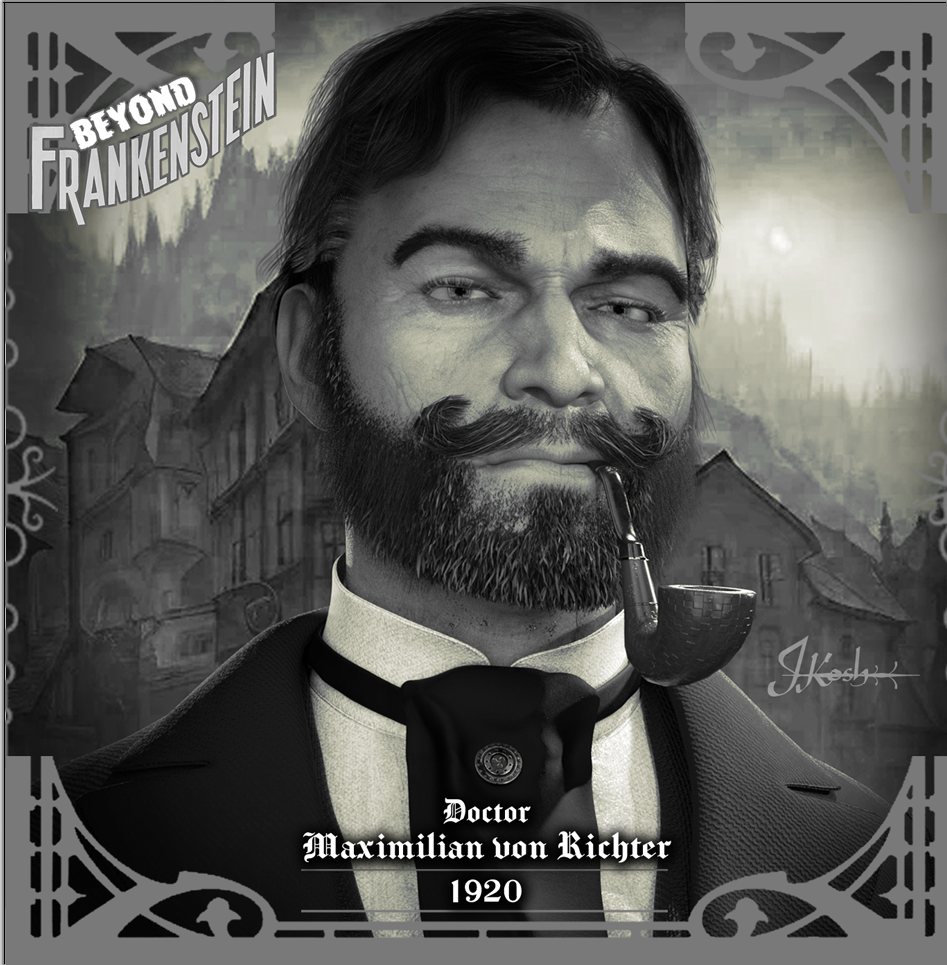
Maximilian von Richter and Hannibal Buchwald
Me: And let me say that she is right. It’s your niche and you shine in it! Okay, next question. When naming your characters, do you give any thought to the actual meaning?
JK: Yes, I do. It’s up to the readers to discover some of the ‘Easter eggs’ behind my names. Sometimes they are chosen because they help me visualize the character in my mind by association. For example, I imagined one of the baddies in Beyond Frankenstein to look like Boris Karloff’s Morgan, the homicidal butler in The Old Dark House. Being a Croat, I called him Boris Kovacs.
Boris Karloff as Morgan in The Old Dark House (1932)
Me: What are the major themes of your work? How long on average does it take you to write a book?
JK: I usually don’t think about themes, but some stuff keeps reappearing in most of my stories. Things like inhuman spirits coming from another place, artificial vs. natural life, and the strong bonds of love and friendship.
Me: As a writer you can most surely weave an internal struggle into your storyline and the reader may not realize it until the end. That’s when your audience has that sudden realization; Oh yeah, I didn’t see that coming. Do you know what I mean? Is that something you do often? A writing style you prefer? Or are your stories an “open book” so to speak?
JK: I always start with the villain. I need to know who they are, what they do, and why they do it. Then I put myself inside the community that is suffering the villain’s actions. How do they react? Finally, I create the main characters, the story’s heroes. However, there was one exception to this process, my novelette FIVE. That one was born out of hearing the voice of the main character inside my mind asking the question, “What would you do if you knew when and where you are going to die?” over and over. It was really bothering me, so I let the guy speak and tell his tale.
Me: Okay, that’s not creepy at all. But at the same time, that would be the question, wouldn’t it? What would you do? I’d want to know…even if I didn’t. But then, if you try to avoid it do you inadvertently end up causing it? I had a similar idea where people are given an amount of time before they would die and one guy steals away to the woods to avoid Death only to get mauled by a grizzly. I never actually penned the idea though. Anyway, who are your target readers?
JK: People who like classic horror movies and ‘old voices’ such as Shelley, Stoker, Lovecraft, and Poe. But most of all, readers that like historical settings, as I love writing tales set in the past.
Me: I get the impression you’re what we would call ‘an old soul’. Right or wrong, it seems to fit your writing. What do you think readers search for in a book?
JK: We are all different. There’s plenty of readers that like stuff I wouldn’t touch; things with a lot of gore and sex, monster romance, urban fantasy. I don’t judge. But they don’t do it for me. Personally, I like gritty stories about ‘human’ monsters and those who hunt them.
Me: And that’s mostly what I write. I tend to call it ‘retail fiction’ because, at the moment, it seems to be what a good portion of the public is searching for. I guess I’m lucky that I enjoy writing what they’re looking for. What is your favorite part of a book?
JK: The part where I finally write ‘The End’.
Me: That is a good feeling, isn’t it? If that’s your favorite, then what is the hardest part of writing for you?
JK: Remaining coherent and focused and avoid wandering off into uncharted—and unnecessary—side stories. Trying to have the right human reactions to the unfolding events. Making sure that all storylines are closed before the end of the book. Going back, after you finish, and fix all those elements that don’t add up.
Me: I gotcha. That was a difficult thing for me to get over. Realizing I didn’t have to cover every minute of every day. Accepting that it’s okay to allow the reader to assume the small details so I can carry on to the next ‘point’ in the story. I know that you’re an awesome graphic artist, but what is the best thing about being an author, as well?
JK: Having readers tell you that they read your story. Sometimes readers don’t realize how much it’s important for us writers to receive feedback. Even negative one.
Me: Agreed! But TBH, the positive feedback is much better received than the negative. For me, anyway. Call it a fragile ego. So, do you listen to music while you write?
JK: Absolutely not. I already have enough trouble at focusing with all the noise around me. Both Auterive and Goldstadt are quite busy places.
Me: I get it. I’ve tried listening to music with words and couldn’t concentrate. But movie scores? Heck yeah. Epic movie scores work even better for me. Lately I’ve been listening to a lot of Celtic and Viking music. It seems to help when there’s a battle scene to be written. What and/or who inspires you?
JK: Random things. It can happen that I watch a movie or read a book and then fall in love with a specific character in the story. So I decide to give that ‘personality’ a twin inside the book I’m writing. Or a specific setting. As I said, The Haunter of the Moor was conceived by my short Halloween holiday in Ireland in 2015.
Me: Have you ever collaborated on a book? If so, who was the other author? How did you collaborate with that author? What writing process did you use?
JK: Never. I’d like to, but I have no idea of how to do that. There is surely a process to co-writing, but… I’m a frigging control freak, so I work better alone.
Me: I get it. I’m the same way. But I’ll admit, I did a trilogy with Jack Wallen a while back and it was a bit rocky at first, but then we seemed to find a groove and I’ll admit, when it was over I was ready to do another one. Maybe one day you’ll find the right partner and attempt something like that. It might be a little challenging at first, but I think the experience helped me as a writer. If you wrote a book about your life, what would the title be?
JK: I would never write a book about my life. Not interested. I know, I have had quite an adventurous life, being born in Rome, Italy, having lived in two states in the US, then Thailand, England, and now France and Wissenheim (heck, now that I think about it, I sound like a fugitive). I have wrestled alligators (small ones), driven a herd, ridden elephants, and being close to many dangerous animals. I have been behind the set of the Babylon 5 TV show and I have played a minor character in the Far Cry 3 video game and short movie. I have met a lot of famous people, including two popes and one Italian president. I have been a delivery boy, a waiter, a concierge, a funeral director for many years, and a smalltime actor. I have lived like an ‘international man of mystery’ for most of my life. But I wouldn’t write about myself.
Me: Dude…you NEED to write your story. My life seems boring in comparison. Let me think…what question have you always wanted to be asked in an interview, but never have?
JK: I think I have covered almost anything.
Me: Okay. What have you written? And what are you working on at the moment? What’s it about?
JK: There are four full novels: Feeding the Urge, Dead Men Tell No Tales, The Haunter of the Moor, and Beyond Frankenstein. Then there are the novelettes and short stories that can be found in personal collections such as Spirits and Thought Forms-Tales from Prosperity Glades and Tales from the Dead. Many of my short stories have been showcased in anthologies. Special mentions should go to Bloody Bones, a Christmas horror tale set in the lovely village of Dunster, Somerset (UK) featured in the A Tree Lighting in Deathlehem (2019) anthology by Grinning Skull Press, and Last Chance, a short psychological thriller that deserves more love, as unfortunately people are barely aware of its existence. You can find this one in the Maximus Shock (2017) anthology by Optimus Maximus Publishing. I also wrote two short erotic novels (Thrill of the Hunt and Home Invasion), and the screenplay for a slasher comedy horror movie that was never shot called Respawn. I’m currently writing a sequel to Beyond Frankenstein which expands on the horrible possibilities offered by the Zeigler Serum and its true, dark origins.
Feeding the Urge (2012), Dead Men Tell No Tales (2012), and The Haunter of the Moor (2016)
Me:Nice! Where can we buy or see them?
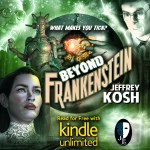
JK: You can either search my name online or visit my website. https://jeffreykosh.wixsite.com/jeffreykosh My stories are all available through the usual channels, except for Beyond Frankenstein; this is a Kindle Unlimited exclusive only available at Amazon. If you are enrolled in their program you can read it for free. Published by JaFra Publishing. https://www.amazon.com/stores/Jeffrey-Kosh/author/B0074F2VGU
Beyond Frankenstein, Kindle Unlimited
Oh, one last thing. I don’t mind if you pirate my books, as long as you don’t make a profit out of it. Then I get pissed and I come after you. They did this trick once with a completely free novelette called Black Brig (my debut fan fiction based on a comic book) and I reacted accordingly. Also, please, if you read my books for free, at least leave a review.
Me: I hadn’t thought of that way, but I guess that’s a positive way to look at the inevitable. Pirates are gonna pirate, so what can you do? What advice would you give to aspiring writers?
JK: Do as you wish and feel. If you want to write good fiction write what you like. If you want to try and make money out of it… follow the trends and the algorithms. I can’t.
Me: Is that a nice way of calling me a sell-out? Just kidding! I actually like writing what I do. Thankfully, the grand majority of it is what people are looking for. Still, sometimes what seems like a heck of an idea in my head ends up flopping on the retail market. Oh, well. I’ll keep writing what interests me. Well, I think we’ve about covered everything. Is there anything that you would like add?
JK: Yes, give Beyond Frankenstein a chance. It’s my best book so far.
Beyond Frankenstein (2025)
Me: Last question, what do you consider your best accomplishment?
JK: Keeping on living, adapting every time I needed to. Living in other countries and respecting their cultures and differences, always mindful about me being a guest. And finally, creating a name in art for myself after so many years of doing the most disparate and non-art related jobs.
The Wunderturm in Goldstadt
As we shake hands, I remind Jeff that he has to work on the cover of Genoswka 6, and then I descend the large stairwell to the first floor. Luckily, Ronny Cicero is nowhere to be seen, probably busy chattering with Richter’s housemaid. When I leave the beautiful townhouse at 22 Kronenstrasse I spot a guy in tuxedo that looks exactly like me. Our eyes meet and then he flees. I chase him amidst the hustle and bustle of the university quarter but I soon lose track of the uncanny man. I think it’s time for me to go back home. Home, before I go crazy and they put me inside a padded cell at Waldenburg Asylum.
Believe it or not, I’m still breathing. You wouldn’t know that looking at this website. Almost TWO YEARS since I last updated this thing? Nearly TWO YEARS since anything was published? Yeah, I really suck at this. No, it’s not the first time I went MIA. Nor is it the first time I’ve tried to come back and beg forgiveness. You can darn well bet that it won’t be the last. Sorry if that doesn’t calm your apprehension.
So, what’s new, you ask? Well, I am purposely trying to force myself into making writing a habit again. I’m sure you’ve read that I pushed too hard and burned myself out. I do that from time to time. It happened during Monster Squad. It happened again in the middle of Caldera. It happened again here. I mean, seriously, Genoskwa came out on a Halloween. G2 was out for Thanksgiving and G3 missed Christmas by a couple of weeks because, well…people have lives and couldn’t be expected to put everything on hold to push out a book during the holidays. But still, three books in three and a half months is…a recipe for burnout. And I thought it would be done with those first three but the push was on to continue the story. So I tried. And it bit me in the rear.
But all is not lost! I’m setting myself a goal and G5 WILL be out for Halloween this year. Just two tiny years after the first one came out. Okay, for those of you who are new here, that isn’t etched in stone. More like drawn in the sand and I’m praying that the tide doesn’t wash it away. But I think it’s a realistic goal. I mean, I hope it is. Look, the point is, I’m back. I’m having to force myself to do something every day and I will continue to do so until it becomes a habit again. I hear that it takes only two weeks to form a bad habit but six weeks to form a good one. I’m looking at at least six weeks to get back into the habit.
My plan is to try to wrap up Genoskwa with Book 6. In all reality, it’s way too difficult to continue a ‘battle’ story from just one point of view. I refuse to try to write from the Sasquatch’s POV because who knows what really goes on in those noggins?! I don’t even like to think of how humans think, or what goes on inside their heads.
Once G6 is out, I’m not even sure which direction I’ll be going. I know I still owe y’all a Bridger story. And there’s been a lot of feedback from folks who want to see another Nick story. And TBH, I’ve toyed with the idea of pulling all of my lead characters and making my own version of The Expendables. Jack Thompson, Daniel Hatcher, Bobby Bridger, Chris Nichols, Josh Forrest, Beans McGee and Dale Archer would make one hell of a force to be reckoned with. Maybe one day. But I also want to try something new. I’ve got a cheat sheet that I write down what I think would make good stories to tell, but man, there’s a bunch. I honestly have no idea if I want to jump into one of those ideas or maybe try something new. I’ve got time to figure that out.
Okay, enough rambling. You got stuff to do and apparently, I have writing to do. I just wanted to announce to my readers that even though I really enjoy doing nothing and binge watching Eureka and BSG and the different Stargate series and a ton of really thought provoking television, I’m going to force my nose to the grindstone, er…keyboard and get back to doing what needs doing.
Cross your fingers for me. Meanwhile, here’s wishing you much love, luck and bacon!
Well, originally we had MS4, Blood Apocalypse, scheduled to be released in May. Then we moved it up to April because of the World Horror Con. Release it early so that we could compile the first four books into one big hardback edition and present it at the WHC in Portland. Then ACX reared its ugly head and stated that if your book wasn’t under contract by March 12th, it fell under their new terms and conditions.
In the immortal words of Gomer Pyle, Surprise, Surprise, Surprise. Guess what gets released 3/10/2014?
If you guessed Monster Squad 4, Blood Apocalypse, then you’d be right!
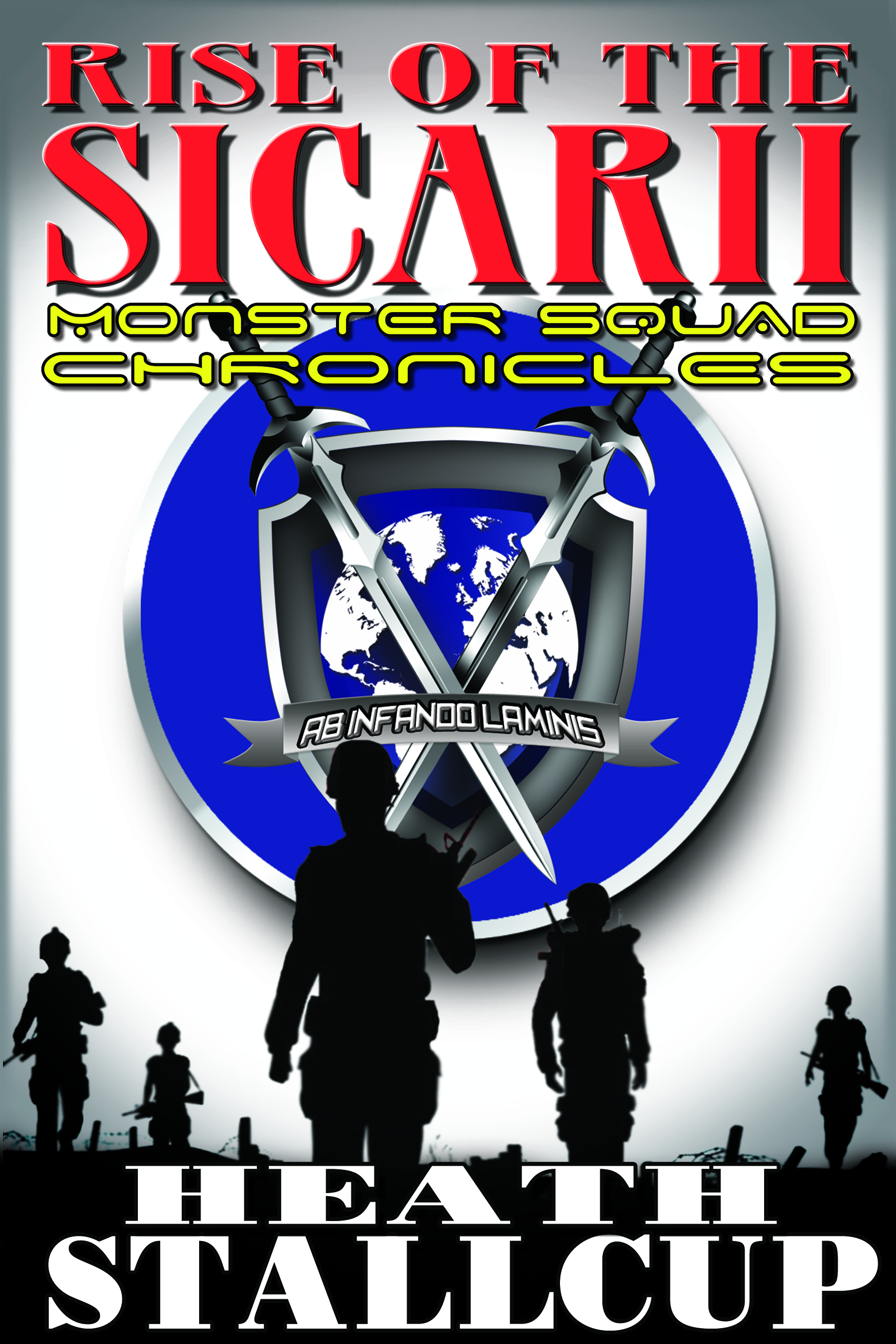
Beside trying to hurry and get MS4 into the system and beat ACX at their own game, there are other reasons for publishing sooner than originally planned. As mentioned, we want to compile the first four squad stories into one very large tome…one complete edition with each story re-edited and rechaptered and attached back to back, telling the epic story of the Rise of the Sicarii from start to finish as it was originally intended. This new hardback edition will be released at the World Horror Convention in Portland and I hope that it will be well received.
I know this is a strange new twist for those who have been following the squads since Phoenix. Usually we plan for a certain date and hold our breath, praying that we can hit close. Something always seems to come up that throws it off, usually at the last minute. But this time, not only are we early, we are WAY early.
So, enjoy it.
Because now the real work begins. Not only do I have to try to promote this, I also have to get MS5 drafted and to Todd for editing. And MS6 and MS7 and…>sigh<
Merry early Christmas y’all.
I’m trying something new. I sort of had to. I’ve been working on MS5 and it’s been an uphill battle the entire way. This is unusual for me because the characters had literally come to life previously. They told their own story. Even after I had decided that the story was finished and I was moving on to other pastures, snippets of their continuing lives continued to bombard my mind at odd times. Like, while driving. Or in the shower. Or while talking on the phone. Key scenes of what ‘should happen next’ flooded my mind while I tried to write other stories. My wife was right (again). I should have written it down…because now that I’m actually trying to WRITE MS5…blank. My mind turns into a wasteland and I can literally hear the winds blowing between my ears. If I close my eyes, I can see tumbleweeds scampering across the dank recesses of my mind.
What to do, what to do??
Start a different book instead, that’s what. And of course, the ideas start flowing again.
So, for the first time, I’m trying to write two different books at the same time. Even though Caldera isn’t scheduled to be released until March, I’m working on the followup to it now and it has gotten the creative juices flowing once more. After sitting at my computer screen and drawing a blank for so long, I’ve found that getting the story down isn’t such a chore. It’s still slow going since I’m bouncing between two stories now and I’m constantly having to remind myself what occurred in the past, at least the creative juices are flowing again and progress is being made.
As pappy used to say, do what you gotta do to get it done. If it means writing two stories to get one out, then so be it.
You know, when I sat down behind my trusty Toughbook and began pounding out what would later become Phoenix, I had no illusions of it ever being read by others. I pretty much expected my wife to read it, tell it me it was horrible and then I would delete it from my hard drive. Four installments and two and a half novels later, I still halfway expect her to tell me that my work sucks when she reads the rough drafts, but so far she hasn’t. There’s still that tiny part of my brain that thinks she’s being kind and sparing my feelings, but…I don’t allow myself to stay there for long. Nearly three quarters of a million words later and she insists that each new offering is an improvement on the last.
Now, I am approaching a point where my hobby is no longer just a ‘hobby’. It is quickly becoming a job. One needs to maintain a presence online in order to promote ones work. One needs to keep readers informed of upcoming releases and possible events. One needs to constantly work to improve the quality of the work you put out because now, it’s no longer a ‘hobby’…you’re a published author! That thought alone can keep you up at nights.
I hear other writers who say that they strive to reach a point where they can quit their day job and write full time. I think about what they say and the ramifications of their statements. At what point are they trading one job for another? When do deadlines and events and promotions become so burdensome that it sucks the fun out of writing? If you truly love your craft, can anything truly suck the joy from it? I suppose these are questions that each writer must ask him or herself. But, the fact remains that what my publisher told me is absolute truth. The easiest part is writing the story. Afterward is when the REAL work comes. Silly me, I thought she was talking about what SHE did!
Boy, was I wrong…
The big question on my mind is still, how do you self promote without becoming a nuisance to others? Is there a secret to that game? Is there a right way or a wrong way? HOW does one go about self-promoting effectively? Once your hobby becomes a job, these questions take on a whole new level of importance and can raise anxiety levels to new heights. The rare example of Joe Schmuck pounding out a book, tossing it up on Amazon and it becoming a ‘best-seller’, getting picked up for TV or a movie, then every golden pearl of wit and wisdom they type from then on becoming a best seller is just…well, it’s dadgum rare. Most books on Amazon sell maybe 50 copies over it’s entire life. For most authors, that won’t cover the cost of their cover art much less editing. So…what is a promising author to do? Turn to the pros, that’s what. And I’ll cover some of what I’ve learned from the masters of the game in a future post.
All things considered, I still wouldn’t trade this hobby/job/profession for any other. I may be quickly approaching my golden years, but I’ve finally decided what I want to be when I grow up!
I’ve spent the last few weeks going over previous works, doing a little self-editing. Cleaning up stories, helping them to flow a little better, smoothing out a few bumps and catching minor errors. My editor gave me a few hints, tips and tricks…minor things you might think, but time consuming for one to have to go through and correct throughout a 400-550 page tome. Since it would be a while before he would be addressing them, I took it upon myself to do it. Along the way, I learned a few more CORRECT ways to do things and applied them as well.
Why would I do this? Well, I was asked this very question.
“Don’t you have an editor to do that?”
“Yes, I do.”
“Why not let him do it then? That’s his job.”
“Because it helps me to IMPROVE my writing by applying these changes myself.”
You see, if I take what he tells me to heart and apply it myself over the course of four to five novels, maybe some of those lessons will stick. My end goal isn’t JUST to write more, but to write BETTER. I want my finished project to be polished. Finished. Refined. As close to perfect as I can produce. Is this because I consider myself a perfectionist, or do I think I write better than so-and-so? No. Not at all. It’s because I strive to better myself in whatever I do. My goal is to improve to the point that Todd need only to open the document, run it through his automatic spell-checker and grammar check, and then sit back and READ the story. I hope to one day improve myself to the point where he feels that his services aren’t needed. Do I honestly think that day will ever come? No, of course not. That is simply a goal to strive toward. That doesn’t mean the goal is actually attainable. Nobody is perfect and no matter how much I may improve, I am humble enough to understand that there is ALWAYS room for improvement. That is why TW Brown is there. He has my back. He makes sure that I don’t step in it and track it all over the carpet.
It doesn’t matter what I’m working on, I try to find ways to improve my work. I’ll give you an example.
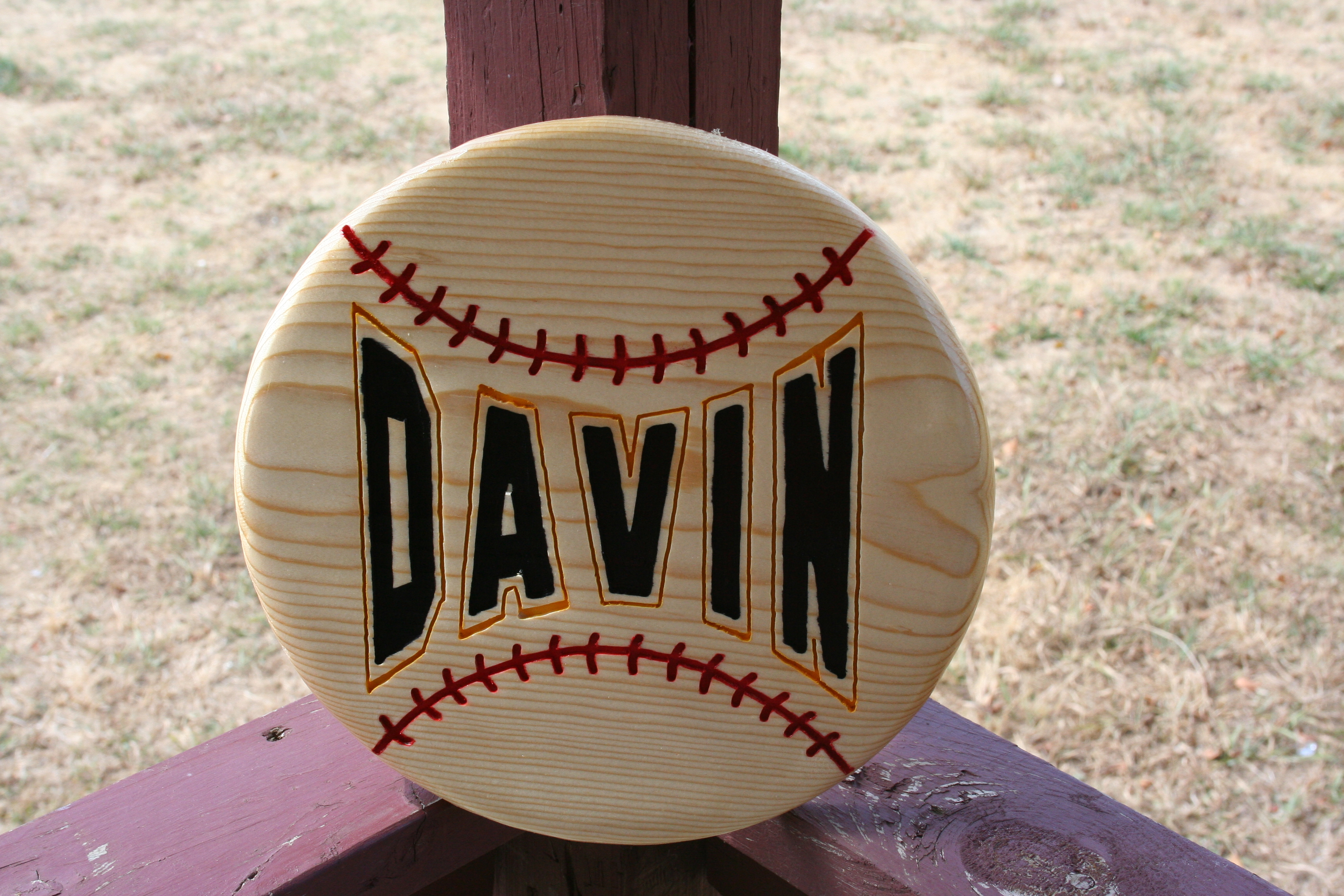
Jess and I started making these little wood signs a few years back. We started with a Dremel tool and would spend countless hours chipping away wood to create these rustic signs with peoples names in them. Then I got the bright idea to use a router. It was faster, cleaner, gave a more professional appearance and cut the time we spent on the signs by hours. The bits were expensive and sometimes the wood would splinter causing us to have to start all over, but, honestly, those were rare. We mostly made baseball and softball signs for the little leaguers in our area and the kids loved them. We experimented constantly trying to find ways to improve what we were doing until we found what worked best and then we stuck to it.
I’m a firm believer in ‘if it ain’t broke, don’t fix it’. But when it comes to something as creative, yet also technical, as writing…well, there’s always room for ‘fixing it’.
You may ask, have I seen any improvement in my writing? Well, to be honest, I haven’t seen any improvement since applying what Todd has told me because that was just recently. I’ve spent my time going back over previous works and making corrections to them. However, I will say that since Phoenix made it’s debut, I’ve had the opportunity to finish three other Monster Squad novels. I’ve finished two unrelated novels, each better than the last (if I’m to believe my missus, and she’s never lied to me yet). I think that with practice, I’m improving. By applying what Todd has told me, I’m also improving. Perhaps only technically, but still improving. Have I reached a point yet where Iconsider myself a ‘writer’ yet?
Nope. Not even close. But I will continue to strive to improve myself with each work that I pass on to be published and hope that you, the reader, will enjoy them more because of it.